The Comfortable Illusion of Color-Coded Risk
Every quarter, boards across the globe review risk registers adorned with familiar red, amber, and green indicators. These heatmaps have become the lingua franca of enterprise risk management, offering what appears to be a comprehensive view of organizational threats. Yet beneath their visual clarity lies a fundamental problem: they tell us almost nothing about what actually matters—the financial impact on shareholder value.
From the CEO's seat of an EPC business I grew to 450 people, and now from the chair of a board I constituted, I have witnessed firsthand how traditional risk heatmaps create a dangerous comfort zone. Directors nod approvingly at color-coded matrices, believing they understand the risk landscape, when in reality they are making governance decisions based on subjective assessments that lack any meaningful financial grounding.
The 2026 Global Board Risk Survey by Deloitte revealed that 73% of directors feel "somewhat confident" in their organization's risk reporting, yet only 18% could articulate the potential financial impact of their top five risks within a reasonable margin of error. This disconnect represents one of the most significant governance failures of our era.
Traditional heatmaps suffer from three critical deficiencies. First, they conflate likelihood and impact into arbitrary categories that obscure rather than illuminate. A "high likelihood, medium impact" risk might represent anything from a $500,000 annual exposure to a $50 million catastrophic event. Second, they invite cognitive biases—risk owners consistently underestimate threats within their domains while overestimating their mitigation capabilities. Third, and most damaging, they provide no basis for rational resource allocation. How does a board decide between investing in cybersecurity versus supply chain resilience when both appear as orange squares on a matrix?
The Financial Quantification Imperative
The shift toward Cyber Risk Quantification (CRQ) and broader financial risk modeling represents more than a methodological improvement—it constitutes a fundamental reimagining of how boards fulfill their oversight responsibilities. Organizations at the forefront of this transformation are adopting Monte Carlo simulations, loss distribution approaches, and dollar-denominated metrics that translate abstract threats into concrete financial terms.
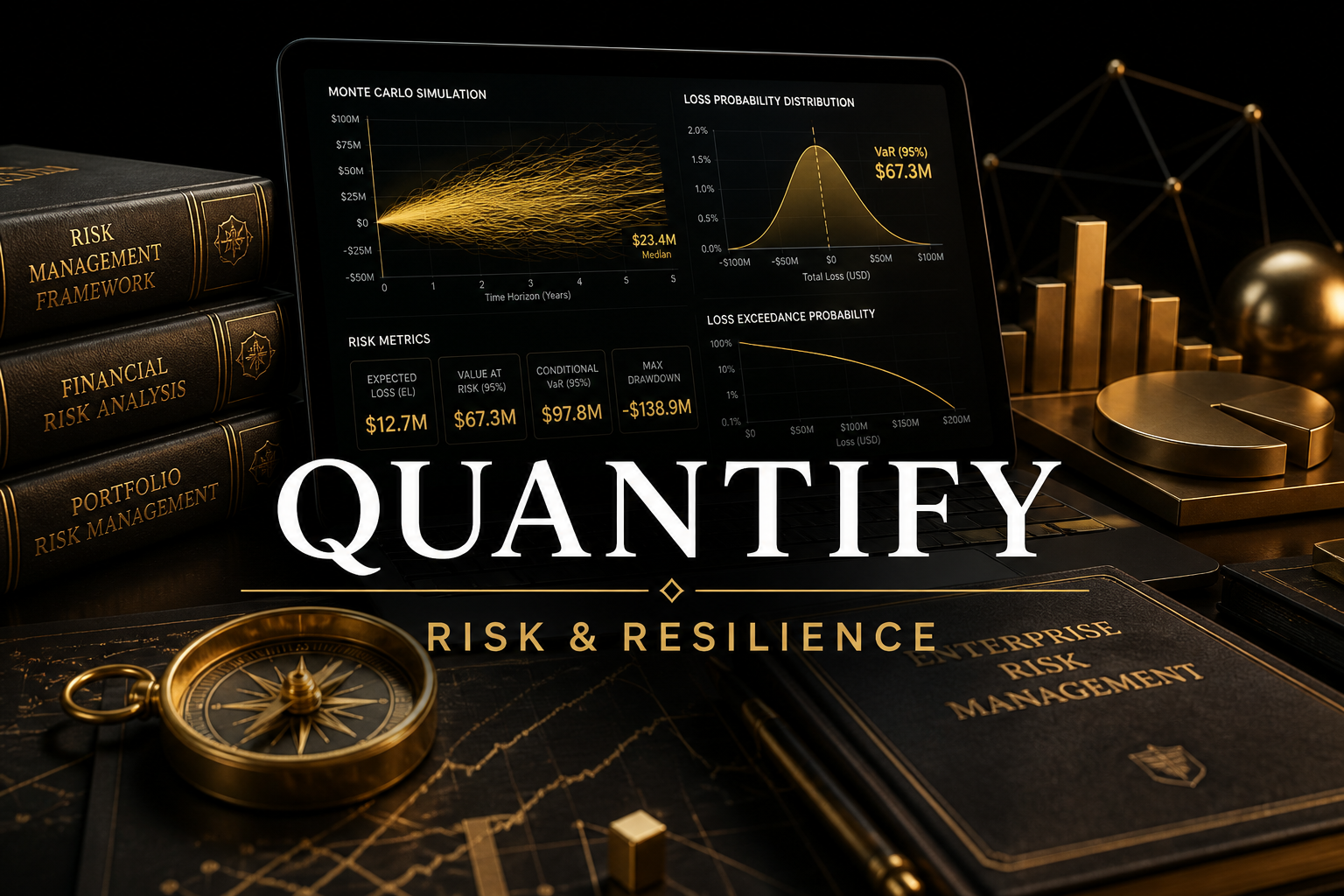
Monte Carlo analysis, borrowed from financial engineering and actuarial science, enables organizations to model thousands of potential risk scenarios simultaneously. Rather than asking "Is this risk high or medium?" boards can now understand that a particular cyber threat carries a 15% annual probability of occurrence with a potential impact range of $8 million to $45 million, yielding an Average Annual Loss (AAL) of $4.2 million. This precision transforms governance conversations entirely.
The FAIR (Factor Analysis of Information Risk) framework has emerged as the leading standard for financial risk quantification, with adoption increasing 340% among Fortune 500 companies between 2023 and 2026 according to the FAIR Institute's annual benchmark study. This methodology decomposes risk into measurable components—threat event frequency, vulnerability, and loss magnitude—enabling organizations to build defensible, auditable risk models.
What makes financial quantification particularly powerful is its ability to aggregate disparate risks into a unified view. When cyber risk, operational disruption, regulatory exposure, and strategic threats are all expressed in the same financial language, boards can finally make informed trade-off decisions. A 2026 McKinsey analysis found that organizations using quantified risk frameworks allocated capital 23% more efficiently than those relying on traditional qualitative methods.
What Boards Must Demand in Risk Reporting
Directors serious about fulfilling their fiduciary obligations should insist on three fundamental metrics in every risk report: Average Annual Loss, loss exceedance curves, and Return on Security Investment.
Average Annual Loss (AAL) represents the expected annual cost of a risk when probability and impact are combined over time. This metric enables direct comparison across risk categories and provides a baseline for budgeting decisions. If your organization's AAL for ransomware attacks is $3.8 million, you have a clear benchmark against which to evaluate proposed security investments.
Loss exceedance curves illustrate the probability of experiencing losses above various thresholds. These curves answer critical questions: What is the 10% probability loss scenario? What is our worst-case exposure at the 1% level? For boards, understanding the tail risk—those low-probability, high-impact events—is essential for capital planning and insurance decisions. I recall a board meeting where presenting a loss exceedance curve for supply chain disruption fundamentally changed our approach to inventory strategy. Seeing that we faced a 5% annual probability of losses exceeding $28 million prompted immediate action that a "high risk" label never would have.
Return on Security Investment (ROSI) quantifies the risk reduction achieved per dollar spent on mitigation. This metric transforms security and resilience from cost centers into value-generating investments with measurable returns. When a $2 million cybersecurity program reduces AAL from $8 million to $3 million, the ROSI calculation demonstrates clear value creation that boards can evaluate alongside other capital allocation decisions.
Beyond these core metrics, boards should demand scenario-specific analyses for emerging threats. What is the quantified exposure from AI-enabled fraud? From climate-related supply chain disruption? From geopolitical sanctions affecting key markets? Each of these questions deserves a financial answer, not a color code.
Fiduciary Duty and Director Liability in the Quantification Era
In 2026, regulatory bodies across many jurisdictions have moved in the same direction. The SEC's updated guidance on risk disclosure now explicitly references quantitative methodologies, while the UK's Financial Reporting Council has incorporated financial risk quantification into its revised Corporate Governance Code. Directors who continue relying solely on qualitative assessments face increasing legal exposure.
The insurance implications are equally significant. Directors and Officers (D&O) insurers have begun differentiating premiums based on risk governance maturity. Organizations demonstrating robust quantification practices are seeing premium reductions of 15-25%, while those clinging to traditional methods face coverage restrictions and exclusions. The market is sending an unmistakable signal about expected standards.
For directors, this evolution demands personal engagement with risk quantification methodologies. While boards need not become statisticians, they must develop sufficient literacy to challenge assumptions, question model inputs, and evaluate the reasonableness of outputs. The era of passive acceptance of management's risk assessments has ended.
A Practical Framework for Implementation
Transitioning from heatmaps to hard numbers requires a structured approach that balances ambition with pragmatism. Based on my experience guiding this transformation in both operating companies and board contexts, I recommend a five-phase implementation framework.
Phase One: Prioritized Scope Definition. Begin with your organization's top ten risks by potential financial impact. Attempting to quantify everything simultaneously leads to analysis paralysis. Focus initial efforts where precision matters most—typically cyber, operational disruption, and regulatory exposure.
Phase Two: Data Foundation. Financial quantification requires data on threat frequency, vulnerability rates, and loss magnitudes. Leverage industry benchmarks from sources like the Ponemon Institute, Verizon DBIR, and sector-specific databases. Where internal data exists, validate it against external sources. Accept that initial models will rely heavily on estimates—this is acceptable and improves over time.
Phase Three: Methodology Selection. Choose a quantification framework appropriate to your organization's maturity. FAIR offers the most comprehensive approach but requires significant investment. Simpler methods like single-loss expectancy calculations can provide immediate value while building organizational capability.
Phase Four: Governance Integration. Embed quantified risk metrics into existing governance rhythms. Risk committee charters should explicitly require financial quantification. Board reporting templates must evolve to feature AAL, loss ranges, and ROSI alongside traditional indicators. Compensation structures should incorporate risk-adjusted performance measures.
Phase Five: Continuous Refinement. Treat risk models as living instruments that improve with each iteration. Conduct post-incident analyses to validate model accuracy. Update assumptions as threat landscapes evolve. Build feedback loops that capture organizational learning.
- Establish clear ownership for risk quantification methodology
- Invest in training for both management and board members
- Create accountability mechanisms for model accuracy
- Benchmark against industry peers and best practices
- Engage external validation for critical risk models
The Board's New Mandate
The transition from qualitative heatmaps to financial risk quantification represents one of the most significant evolutions in corporate governance this decade. Directors who embrace this shift will make better decisions, allocate resources more effectively, and fulfill their fiduciary duties with greater confidence. Those who resist will find themselves increasingly exposed—legally, financially, and reputationally.
As someone who navigates risk daily in the construction and engineering sector while chairing a board and running an engineering business, I have seen how financial quantification transforms governance conversations. When directors can debate whether a $4 million annual investment is justified by a $12 million reduction in expected losses, they are engaging in genuine strategic oversight rather than theatrical risk review.
The question for every board is no longer whether to adopt financial risk quantification, but how quickly they can implement it. In a world where threats multiply and stakeholder expectations intensify, hard numbers are not merely preferable to heatmaps—they are essential to responsible governance.